
Draft — awaiting Technical contact, page not indexed
Gum Tragacanth or Gum Arabic: Choosing Between E413 and E414
E413 and E414 are both natural hydrocolloids, but they behave differently. A practical comparison of solubility, viscosity, emulsification and acid stability for formulators specifying either.
Before this can be published
- Alpha Nova's own assay ranges, grades held, viscosity specifications under stated method, and MOQ for both gums. Insert as a specification table before publishing. Do not publish with generic figures.
Two natural gums, both approved food additives, both sold as thickening and stabilising agents. They are not interchangeable, and substituting one for the other on price alone is how formulations fail.
The short version: gum arabic dissolves at very high concentrations and produces low viscosity, which makes it an emulsifier and a carrier. Gum tragacanth produces high viscosity at very low concentrations and holds up in acid, which makes it a thickener and a suspending agent. If you need to stabilise an oil-in-water emulsion, you want E414. If you need body in a low-pH sauce, you want E413.
Everything below is the detail behind that.
Where they come from
Gum arabic (E414) is the dried exudate of Acacia senegal and Acacia seyal trees, harvested principally across the African gum belt: Sudan, Chad, Nigeria and neighbouring states. Sudan has historically dominated world supply, which is why gum arabic pricing and availability track political stability in that region closely. Buyers who have been in this market a while will remember what supply disruption there does to contract prices.
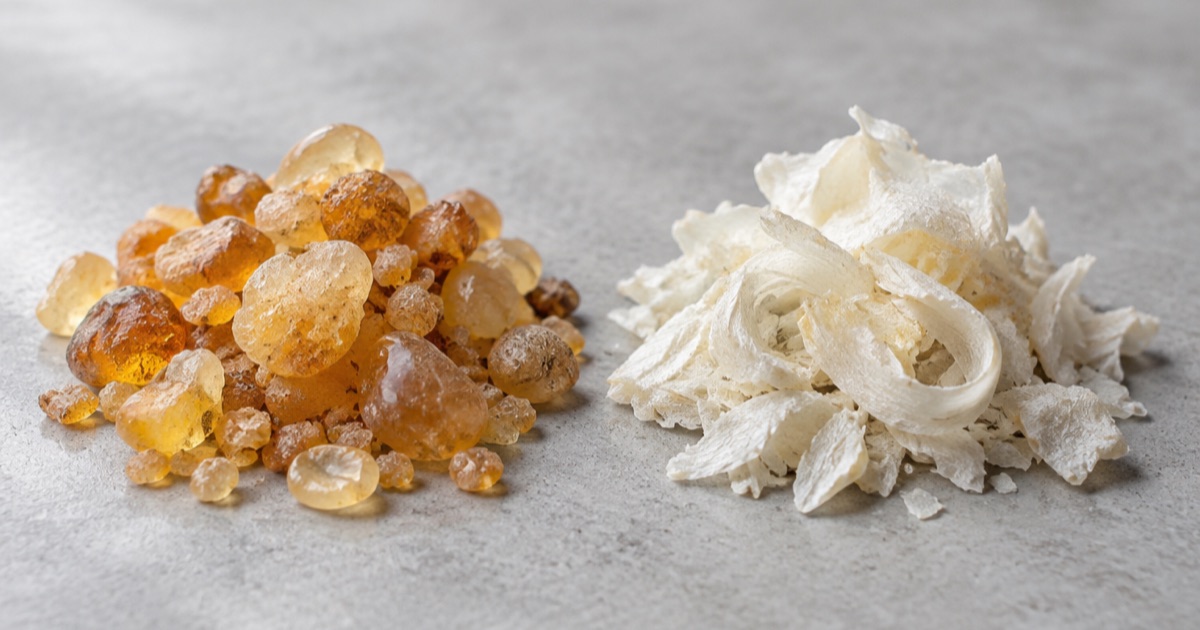
Gum tragacanth (E413) is the dried exudate of several Astragalus species, principally Astragalus gummifer, harvested in Iran, Turkey and Syria. It is tapped from the shrub by hand, sorted by grade, and supplied either as ribbons or as milled powder. Production volumes are far smaller than gum arabic and the harvest is more labour-intensive, which is the main reason tragacanth carries a significantly higher price per kilogram.
That origin difference matters commercially beyond price. The two gums have almost no overlap in their supply risk, so a formulation that can tolerate either has a hedge that a single-gum formulation does not.
How they behave
This is where the two genuinely diverge.
Solubility. Gum arabic is exceptionally soluble in water. It will go into solution at concentrations well above what most hydrocolloids tolerate, and it does so without forming a gel. Gum tragacanth does not truly dissolve. It swells, absorbing water to form a viscous colloidal dispersion, and it hydrates slowly. A formulator moving from one to the other has to change the process, not just the ingredient.
Viscosity. Directly related to the above, and the clearest practical distinction. Gum arabic solutions stay low in viscosity even when heavily loaded. Gum tragacanth builds substantial viscosity at fractions of a percent. If your target is a thick product, tragacanth does it with a fraction of the inclusion. If your target is a high-solids solution that still pours and sprays, arabic does what tragacanth cannot.
Emulsification. Gum arabic is one of the few hydrocolloids that is a genuine emulsifier rather than simply a stabiliser. It carries a protein fraction bound to its polysaccharide structure, and that protein anchors at the oil-water interface while the carbohydrate keeps the droplet dispersed. This is the property that made it the standard in beverage emulsions and it is not something tragacanth replicates.
Acid stability. Gum tragacanth holds its viscosity in low-pH systems better than most natural gums, which is why it appears in dressings, sauces and acidified products where other thickeners thin out.
Film forming. Both form films. Tragacanth's are stronger and it is the traditional choice in applications needing a workable, setting paste.
Typical applications
| Application | Usually E414 | Usually E413 |
|---|---|---|
| Beverage flavour emulsions | Yes, the standard choice | No |
| Flavour encapsulation and spray drying | Yes, the standard carrier | No |
| Confectionery, gums and pastilles | Yes | Occasionally |
| Acidified sauces and dressings | No | Yes |
| Suspending solids in a liquid | Rarely | Yes |
| Pharmaceutical tablet binding | Yes | Yes |
| Cosmetic emulsions and creams | Yes | Yes, as a thickener |
Regulatory and dietary status
Both are permitted food additives in the EU, carry E numbers, and are listed in Codex under the same INS numbers. Both are plant exudates with no animal-derived input at any stage, which makes them suitable for vegetarian and vegan formulation and straightforward to certify halal and kosher. Neither carries a numerical acceptable daily intake in the usual sense, the additives having been evaluated as not requiring one at normal use levels.
That said, permitted status is not the same as permitted for your application at your inclusion rate in your market. Check the current authorised use conditions for the specific food category and territory you are selling into, because those are what an auditor will ask about.
Can you substitute one for the other?
Sometimes, but rarely cleanly.
Going from tragacanth to arabic, you will lose viscosity, and you cannot simply add more arabic to compensate without changing the solids balance of the product substantially. Going from arabic to tragacanth in an emulsion, you lose the interfacial activity that was holding the emulsion together, and a thicker continuous phase is not the same thing as a stabilised droplet.
Where substitution genuinely works is in straightforward thickening applications with neutral pH and no emulsion to hold, and even there expect to reformulate and retest rather than swap at equal weight.
The more common real-world question is not which one, but whether a blend does the job better than either alone. That is worth testing if you are working at the edges of what a single gum handles.
Specifying either one
Whichever you select, the specification questions are the same. Ask for the assay and purity limits, moisture and ash, heavy metals, microbiological limits, particle size or mesh where it is supplied as a powder, and viscosity measured under a stated method and concentration. Viscosity figures are meaningless without the method attached, and a supplier who quotes one without the other is telling you something.
Ask also for the origin, the harvest season where relevant, and confirmation of certification status. For tragacanth in particular, grade and form affect performance enough that "gum tragacanth" on a quotation is not a complete specification.
Working with Alpha Nova
Alpha Nova supplies both gum arabic (E414) and gum tragacanth (E413) to food, beverage, pharmaceutical and cosmetic manufacturers, consolidated through our Dubai Silicon Oasis hub and drawing on the sourcing relationships built over two decades by our German partner Aromaplant GmbH.
If you are specifying either gum and want to compare against your current supply, request a specification sheet and a certificate of analysis sample. We will send both without a form.