
Draft — awaiting Technical contact, page not indexed
Liquorice Extract as a Tobacco Casing Agent: What to Specify
Liquorice is one of the oldest casing materials in tobacco manufacture. What it does in a blend, which specification parameters actually govern performance, and what to ask a supplier.
Before this can be published
- Alpha Nova's own liquorice grades, forms held in stock, glycyrrhizin ranges with the method stated, MOQ and typical lead time to UAE manufacturers. Insert as a specification table before publishing. Do not publish with generic figures.
Liquorice has been used in tobacco manufacture for well over a century, and it remains one of the most widely used casing materials in the industry. It is not a flavour in the way a top note is a flavour. It is a casing: applied to the blend earlier in the process, in larger quantities, doing structural work as much as sensory work.
If you are buying it, the specification questions are different from the ones you would ask about a top-note flavour, and getting them wrong is expensive at the scale casings are used.
What a casing does
A casing is applied to the tobacco leaf or cut filler before the final flavour is added. It carries several jobs at once.
It contributes sweetness, which is the property liquorice is best known for in this application. It supports moisture retention, which matters for both processing behaviour and the stability of the finished product. And it rounds the blend, softening harsher characteristics of the base tobacco rather than adding a distinct identifiable note.
The practical consequence is that casings are dosed at inclusion rates far above those of top-note flavours. Which in turn means that lot-to-lot variability in the casing material shows up in the finished product much more readily, and that the cost per kilogram of the casing has a material effect on blend economics.
Both of those point to the same conclusion: specification consistency matters more here than it does for a material you are adding in parts per million.
The parameter that governs everything: glycyrrhizin
Liquorice extract is standardised on glycyrrhizin, the compound responsible for its characteristic sweetness. This is the single most important number on the specification, and the one your dosing is calculated against.
A blender working to a fixed recipe needs the glycyrrhizin content to sit within a known band, lot after lot. If it moves, the sweetness contribution of the casing moves with it, and the blend has to be corrected. Correcting a blend after the fact is far more expensive than specifying the material properly at the outset.
Three things to establish with any supplier:
- The specification range, not a single figure. Real material scatters within a band; a supplier quoting one number is quoting a target, not a specification.
- The method used to determine it. Assay figures obtained by different methods are not directly comparable. A number without a method attached cannot be checked against anything.
- Whether the figure is on a dry basis. Moisture varies, and an assay quoted as-is on a wetter lot is not the same material as the same assay quoted dry.
That third point catches people out more often than it should. Two certificates can show the same assay figure and describe materially different material.
Form, and why it changes the conversation
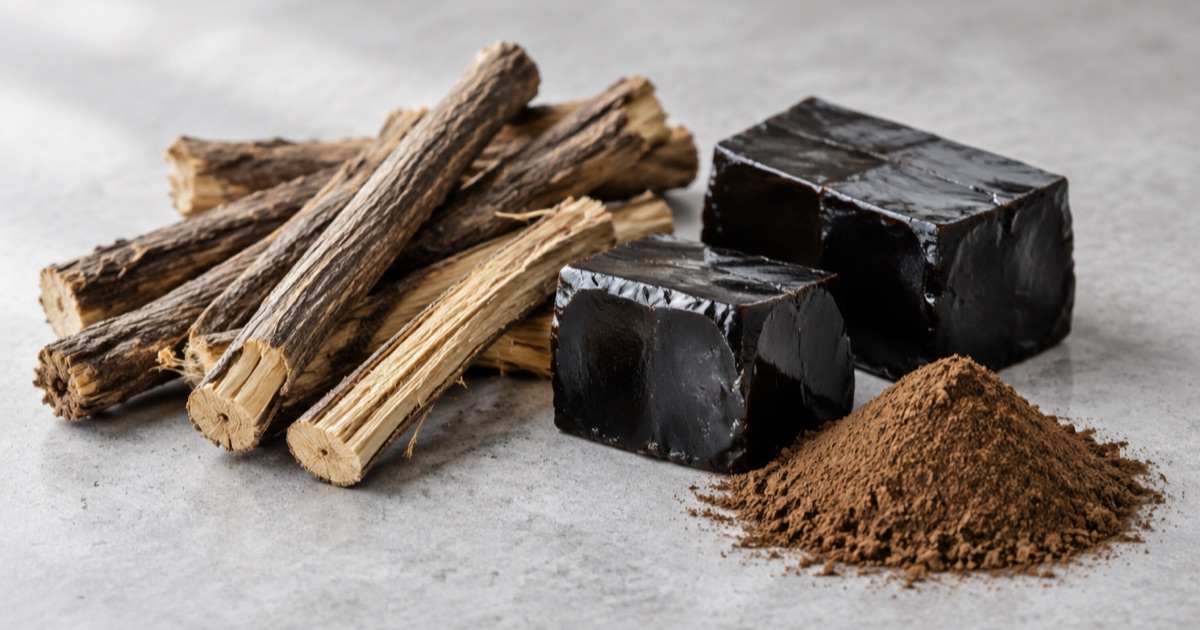
Liquorice extract is supplied in several physical forms, principally as blocks, as spray-dried powder, and as liquid concentrate or paste. The form is not a packaging detail. It determines how the material enters your process.
A block has to be dissolved, which means heat, time and a vessel. A spray-dried powder disperses more readily but carries different handling and dust considerations, and its solubility behaviour needs to be confirmed against your process conditions rather than assumed. A liquid or paste avoids the dissolution step but has different storage and stability requirements, and you are paying to ship water.
Specify the form explicitly. "Liquorice extract" on a purchase order is not a complete specification, in the same way that "gum tragacanth" is not.
The rest of the specification
Beyond assay and form, the parameters worth pinning down are the ones that affect storage stability, process behaviour and compliance.
Moisture and ash. Moisture affects how much active material you are actually buying, and it affects microbiological stability through storage. For a hygroscopic material shipped into a humid climate, the figure at the factory and the figure on arrival are not necessarily the same, which is an argument for knowing the packaging and the storage conditions as well as the number.
Microbiological limits. Liquorice is a root extract, and plant material carries a natural microbial load that extraction does not automatically eliminate. Total plate count, yeasts and moulds, and specified pathogens should all appear on the certificate with the sample basis stated.
Heavy metals. Root materials draw from the soil they grow in, which makes heavy metals a meaningful parameter for liquorice rather than a box-ticking one. Limits should be stated alongside results so you can see which standard is being applied.
Solubility and particle size where the material is supplied as a powder, because these govern whether it behaves on your line.
Origin. Growing region affects the material, and it affects supply continuity. Knowing where a lot came from is part of knowing what you have bought.
Our guide to reading a certificate of analysis covers how to check these once the certificate is in front of you.
Regulatory position in the GCC
Additives used in tobacco products across the GCC are governed by a permitted-additives framework rather than left open. GSO Technical Regulation 2390/2014 sets out lists of additives that are permitted and prohibited in tobacco products, and sugars and sweetening materials appear on the permitted list.
Two practical implications follow.
First, the regulatory question for a casing material is whether it sits within the permitted framework for the market you are manufacturing in, which is a documentation question as much as a composition one. Your supplier should be able to tell you what the material is and what is in it, in enough detail for you to answer that question yourself.
Second, permitted status is market-specific and subject to change. Confirm the current position for the territory you are selling into rather than relying on a general statement, including any statement in this article.
What to ask a supplier
A complete enquiry for a tobacco casing material specifies the form, the glycyrrhizin range and the method it is measured by, the moisture and microbiological limits you require, the packaging, and the volume and delivery pattern you expect. It asks for the specification sheet and a representative certificate of analysis before an order rather than after.
It also asks about continuity. Casings are used in volume, and a material you cannot re-buy on the same specification in six months is a reformulation waiting to happen.
Working with Alpha Nova
Alpha Nova supplies liquorice extract and natural flavour systems to manufacturers across the UAE and wider GCC, consolidated through our Dubai hub and drawing on sourcing relationships built over two decades by our German partner Aromaplant GmbH.
If you are qualifying a casing supplier, ask us for the specification and a representative certificate of analysis. We will send both without a form.